
Research equipment is intended for conducting experiments in research, observation, and measurement across various scientific and technical fields. It includes precise measuring instruments, laboratory devices, specialized computer systems, and tools for data acquisition, processing, and analysis. Its use enables hypothesis verification, development of new technologies, and the acquisition of reliable and repeatable results, which form the foundation for scientific progress and innovation.
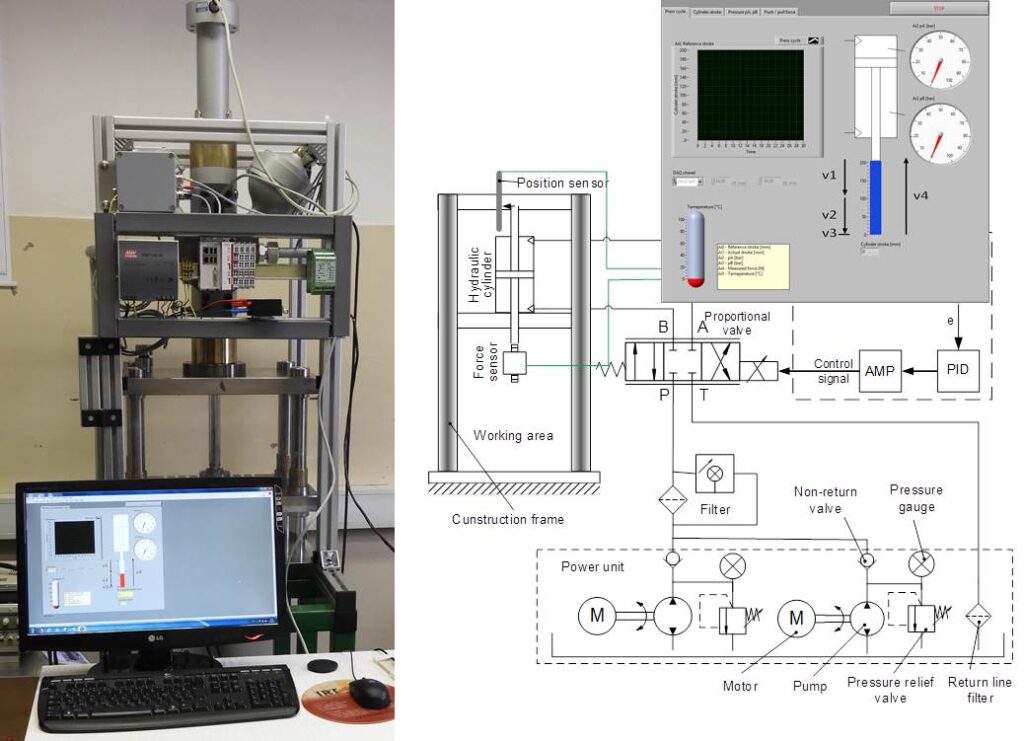
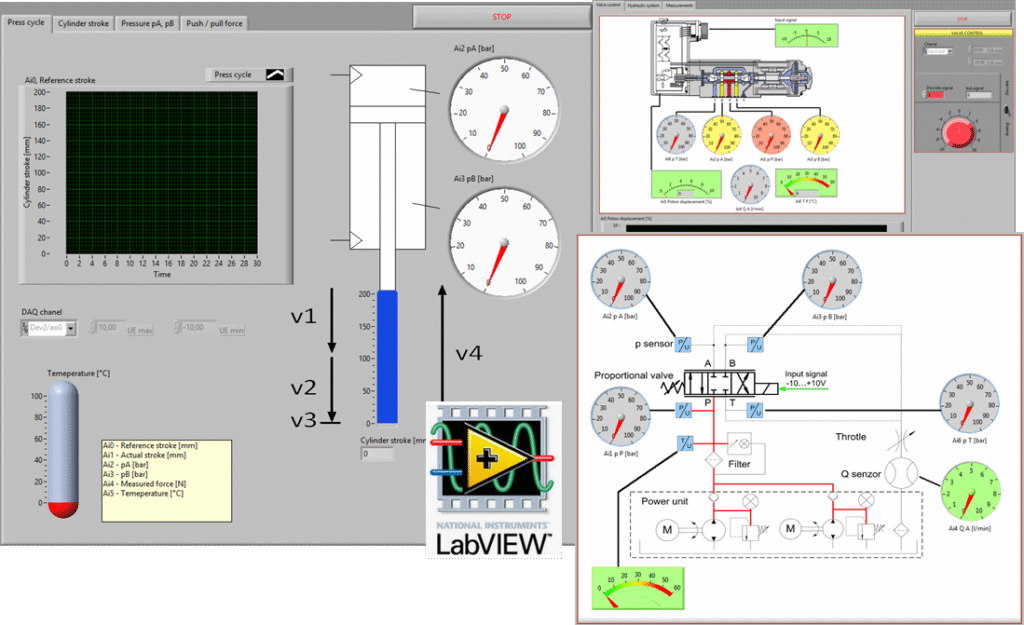
Experimental station – hydraulic servo press
- Use of servo technology, servo linear axes controlled by servo valves,
- use of displacement, pressure, force, temperature, and other sensors,
- control using NI LabVIEW software, Beckhoff CX 9020 PLC, and TwinCAT,
- data acquisition, visualization, monitoring, and storage of measured variables,
- implementation of closed-loop control (PID control, position, pressure, force control, cycle generation),
- development of cycles for various applications in hydraulic production systems or test devices.
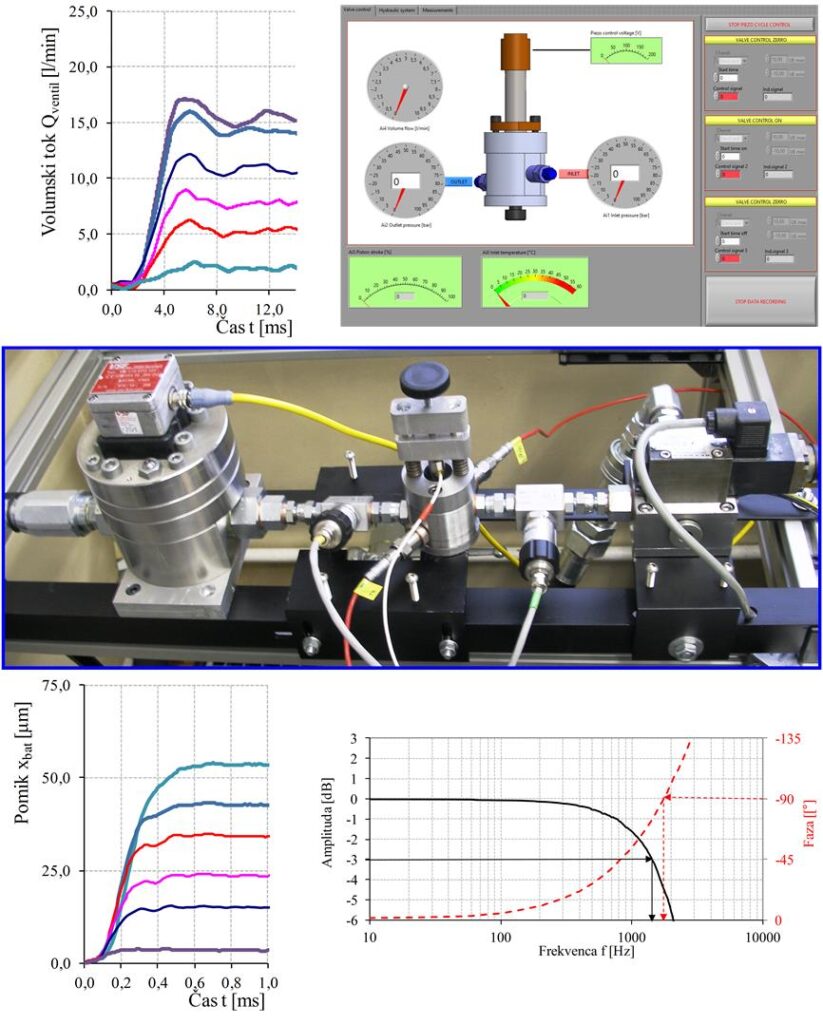
Experimental station for measuring characteristics of high-dynamic piezo valves
- Measurement of static and dynamic characteristics of valves (flow characteristics, pressure characteristics, valve response time, frequency response),
- measurement of actuation force (force required to switch the valve depending on spool material, spool geometry, friction forces between spool/housing/seals, influence of spool geometry on pressure and flow forces).
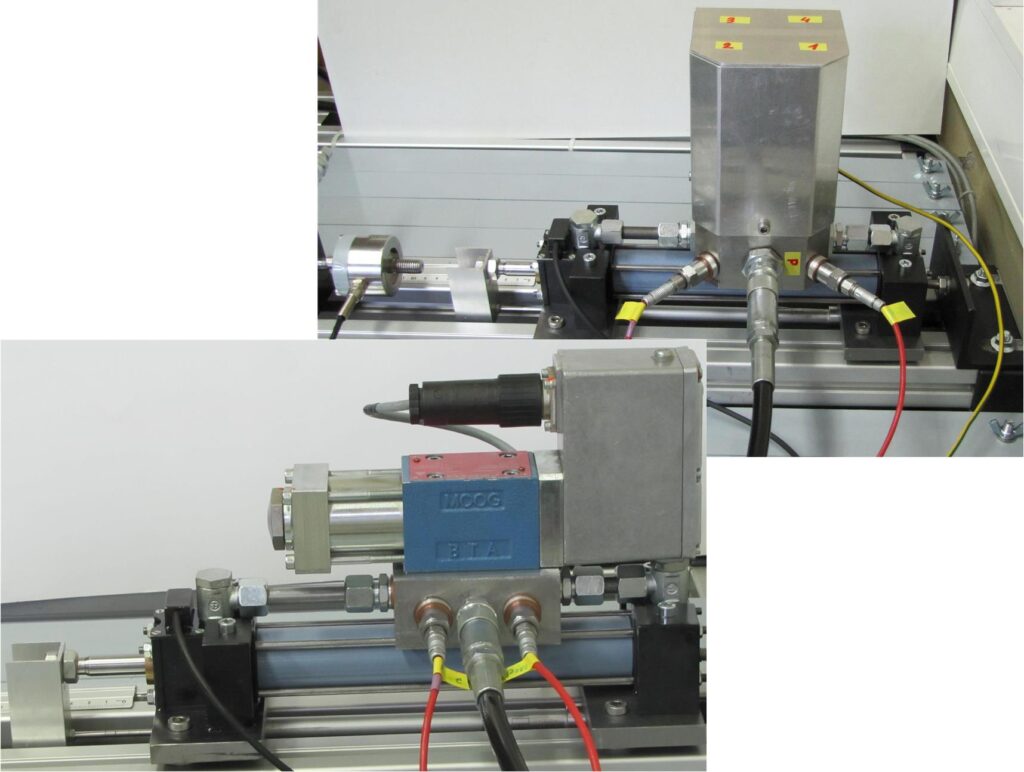
Experimental station for measuring characteristics of high-dynamic hydraulic linear axes
- Controlled by digital piezo valves,
- controlled by proportional and servo valves,
- measurement of static and dynamic characteristics (especially position accuracy, stroke resolution of the hydraulic cylinder, and response to external disturbances),
- comparison of conventional PID control with advanced control algorithms.
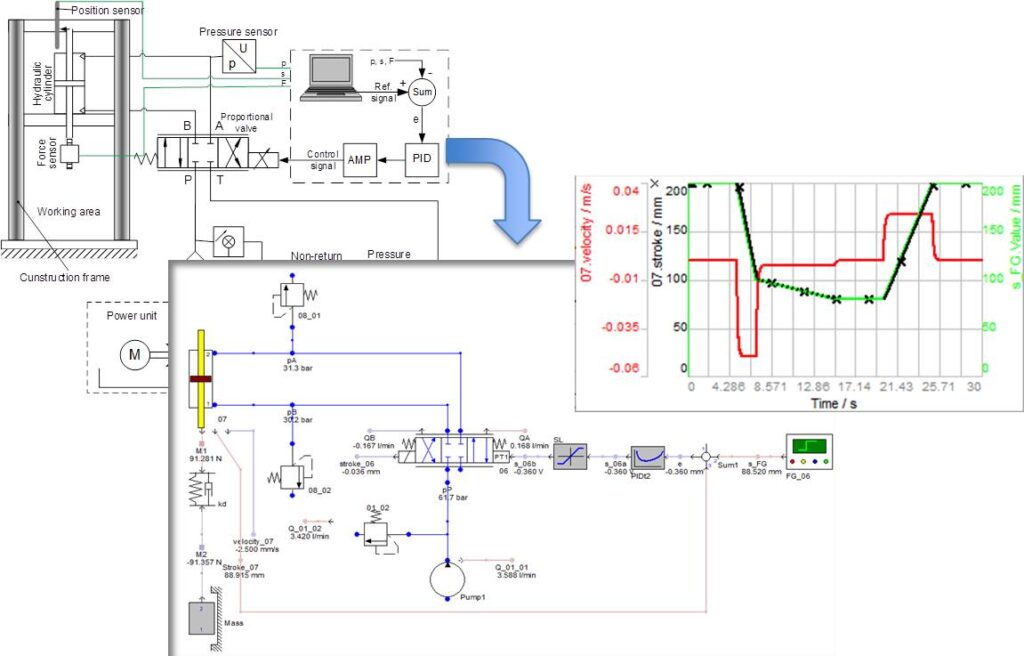
Simulation tool DSHplus
- Modeling, simulation, and optimization of complex fluid power components and systems in a virtual environment,
- used for design, calculation, and dynamic analysis of hydraulic and pneumatic systems,
- provides tools for handling nonlinear system behavior,
- enables evaluation of static and dynamic behavior of systems in the design phase,
- supports dynamic analysis of existing hydraulic and pneumatic systems.
Results of simulation use:
- systems optimally adapted to technical requirements
- reduced costs and time for prototype development and testing
- optimal selection of components during system design
Software tools NI LabVIEW and NI DIAdem
- Creation of graphical user interfaces using NI LabVIEW for controlling components and systems, data acquisition, visualization, storage, and signal processing,
- NI DIAdem – statistical analysis of measured data and generation of measurement reports.
Simulation tool Siemens Tecnomatix Plant Simulation
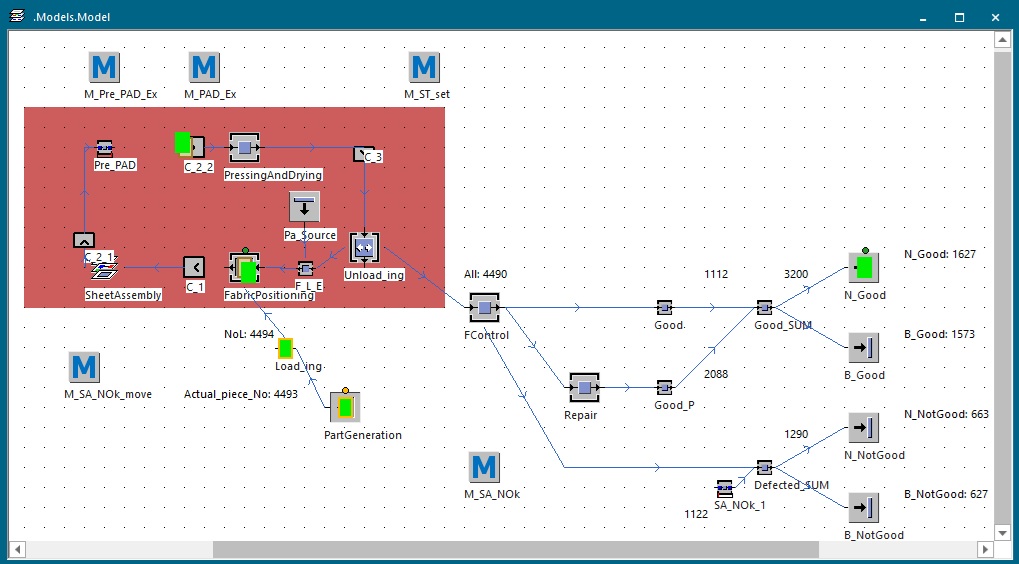
- Software tool for discrete-event simulation and optimization of production and logistics systems,
- enables modeling, analysis, visualization, and optimization of material flow, warehouses, production lines, and entire factories,
- supports 3D visualization and CAD model import for realistic layout representation,
- includes statistical analysis, reporting tools, Gantt charts, Sankey diagrams, and other analytical outputs,
- enables “what-if” scenario analysis to evaluate changes before implementation,
- supports optimization using advanced methods such as genetic algorithms, design of experiments, and automated experimentation,
- object-oriented and hierarchical approach enables model reuse and faster development of complex systems,
- used in the laboratory for research and teaching in production logistics, assembly lines, quality control, and sustainable solutions.
Experimental station for measuring flow characteristics of directional valves with special control edges
This experimental station is designed for investigating the flow behavior of directional control valves equipped with specially shaped control edges. It enables precise measurement of flow rate as a function of pressure drop and spool position, allowing detailed analysis of valve performance under different operating conditions. The setup is used to evaluate hydraulic losses, flow forces, and nonlinear effects caused by the geometry of the control edges. The results support the development and optimization of high-performance hydraulic components and contribute to improved accuracy and efficiency of fluid power systems.
Experimental station for measuring static and dynamic characteristics of mechanical piezo amplifiers
This experimental station is intended for the analysis of static and dynamic behavior of mechanical piezo amplifiers. It enables precise measurement of displacement amplification, stiffness, response time, and frequency-dependent characteristics under different loading conditions. The setup allows evaluation of nonlinear effects, hysteresis, and dynamic amplification performance. The obtained results are used to improve the design and control of piezo-based systems and to enhance their accuracy, responsiveness, and overall efficiency in precision applications.