
Research and Development Areas and Activities
LASIM – Laboratory for Material Handling, Assembly, and Pneumatics – has, over the past two decades, focused on the development of advanced innovative processes and systems in manufacturing technologies, encompassing key Industry 4.0 technologies.
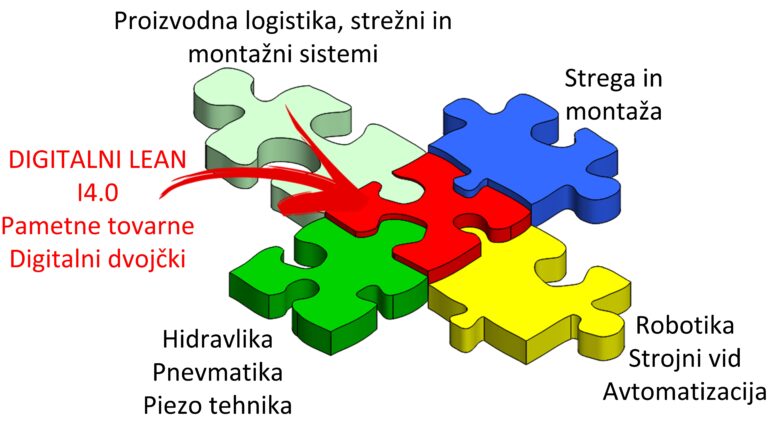
Laboratory LASIM scope of the research.
The most important field cultivated in the laboratory over the last two decades is the modeling, simulation, and optimization of production and logistics processes in manufacturing technologies. In this context, we particularly emphasize DIGITAL LEAN and the DIGITALIZATION OF PROCESSES AND SYSTEMS, which are in fact integrated into all other research areas and represent the central foundation of our work.
Within the framework of Industry 4.0, our focus is on:
- Conceptualization of smart factories as intelligent distributed systems
- Digital twins of processes and systems
- Intelligent decision-making and data management algorithms (Artificial Intelligence – AI)
- Modeling, simulation, optimization, and monitoring of production processes
- Innovative strategies for implementing new technologies into existing systems
- New architectural models of smart factories
- Distributed systems, connectivity, and communication
- Internet of Things (IoT)
- Edge computing
- Cloud technologies
- 3D printing in manufacturing processes
- Augmented Reality (AR) and Virtual Reality (VR)
- RFID technologies for material tracking
- Robotics in manufacturing
- Advanced manual assembly stations (Industry 4.0) with collaborative robots
In our research activities, we collaborate with leading institutions in Slovenia as well as innovative and successful companies. In addition to national-level cooperation, we are also connected with international partners within European projects and initiatives.
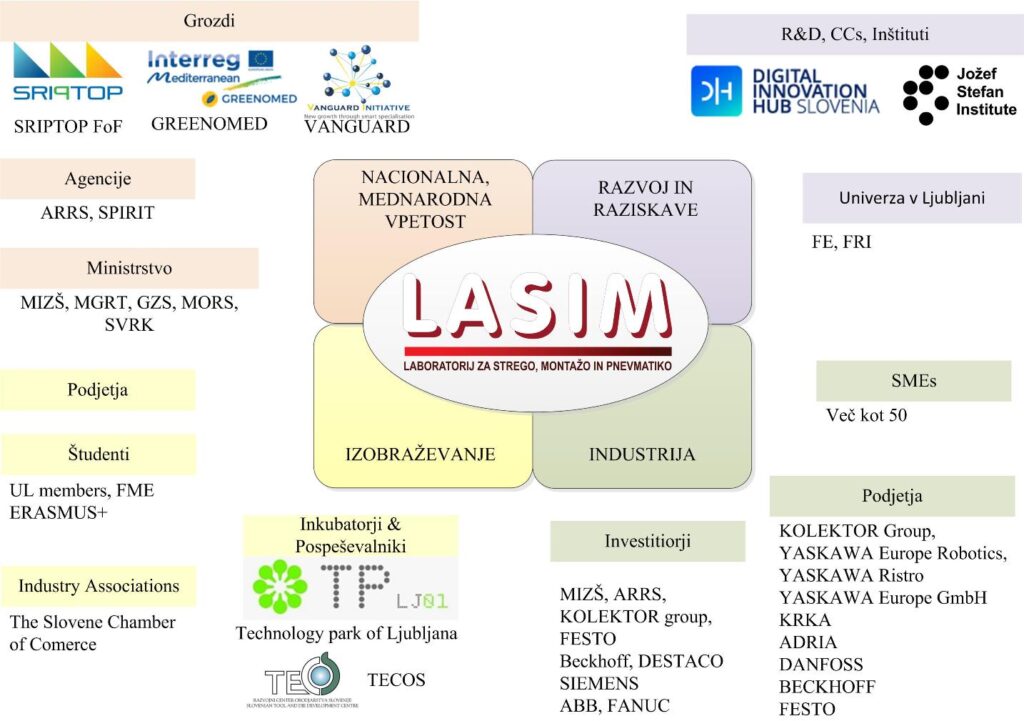
Co-operation in various areas.
Digital Lean, Industry 4.0, Smart Facto
LASIM Laboratory focuses on research into innovative processes and systems within the framework of Industry 4.0, with Digital Lean and process digitalization as a central element. This means that all methods of process improvement, waste reduction, and resource optimization integrate digital tools, simulation, real-time monitoring, artificial intelligence, the Internet of Things (IoT), edge computing, and smart factory technologies.
Smart factories are envisioned as distributed, intelligent systems where processes are interconnected, and automation and communication enable fast adaptation, monitoring, and optimization. Digital twins of processes and systems serve as tools for simulating “what-if” scenarios, enabling decision-making based on modeling, optimization, and simulation before changes are implemented in the physical production system.
Within this framework, LASIM also develops decision-making algorithms, strategies for introducing new technologies into existing processes, smart factory architectures, and the integration of AR/VR technologies, RFID systems, collaborative robots, and advanced manual assembly stations as part of digitalization and Lean approaches.
Production Logistics, Feeding and Transport Systems
In the field of production logistics, LASIM focuses on planning, modeling, simulation, and optimization of material, resource, and information flows within production systems. This includes warehouse systems, transport equipment (e.g., conveyor belts, automated transporters, AGVs), transport routes, and the use of tools ranging from manually operated to fully automated systems.
Research also covers efficient servicing of assembly and feeding stations, transport time management, reduction of movement times, and optimization of space utilization and energy consumption in logistics processes. Simulation, statistical methods, and flow analysis are frequently used to identify bottlenecks, improve throughput, and reduce costs.
This field is essential for linking physical material flow with its information backbone, as logistics significantly affects efficiency, flexibility, and sustainability of production systems.
Material Handling and Assembly
The field of material handling and assembly focuses on the movement of materials, resources, and components (handling) as well as the actual assembly processes. LASIM investigates joining techniques, assembly operations, manual assembly, ergonomic aspects, product design for assembly, assembly lines, automation of assembly using manipulators and robots, as well as control and testing in assembly processes.
Research includes optimization of assembly stations and lines, selection of assembly cells, design of assembly structures, manual and automated assembly procedures, and the introduction of innovations to improve quality, productivity, and error reduction. Project work and simulation enable prediction of the effects of changes in assembly processes before implementation.
This field is crucial because assembly often represents a significant share of production cost, time, and environmental impact in manufacturing systems.
Automation, Robotics, and Machine Vision
Research in automation, robotics, and machine vision involves the development of intelligent systems for automated execution of production operations, the use of robots (including collaborative robots), manipulators, and programmable automation systems, as well as integration of machine vision for quality control, defect detection, and support in assembly or production processes.
Machine vision enables optical sensing, measurement, object recognition, and tracking, which are essential in automation. This field also includes advanced sensor systems, algorithms for image-based data analysis, and integration of these solutions into production environments.
The goal is to achieve higher levels of autonomy, precision, and repeatability, reduce reliance on manual operations, improve safety, and minimize errors. The research leverages simulation, digital twins, artificial intelligence, and integration with Lean methodologies and digitalization.
Hydraulics, Pneumatics, and Piezo Technology
This research area focuses on understanding and applying various actuation and drive systems in hydraulics, pneumatics, and piezo technologies within production and assembly applications.
Hydraulic systems are used for high force and power applications, pneumatic systems for fast response and simpler design, while piezo technologies enable highly precise movements, vibrations, or high-resolution sensing. LASIM develops systems, actuators, valves, and control solutions and integrates them with other technologies such as robotic arms, machine vision, and digital twins.
Research includes control capability, responsiveness, precision, efficiency, and stability of these systems under different conditions. Methods include measurement instrumentation, simulation and optimization, experimental prototypes, and application-specific adaptations (assembly, transport, manipulation).
Through this field, LASIM contributes a key technological foundation for automated and sustainability-oriented manufacturing systems.
Publications
.